High efficiency furnace rebates in NY: Check your eligibility

High-efficiency furnace rebates in NY depend on the program, your utility, and the equipment you install. These are separate pathways, so qualifying for one does not automatically qualify you for another.
It is reasonable to want clear information before committing to a heating upgrade, especially when contractor requirements, pre-approval, or deadlines may affect a rebate. This guide explains how to review EmPower+ eligibility, find rebates available for your address, and understand the rules that may apply before work begins. You will also learn how to plan a furnace or heat-pump upgrade with the right information in hand. For seasonal planning, see our webpage for pre-season specials.
Table of Contents
New York EmPower+ energy efficiency upgrades
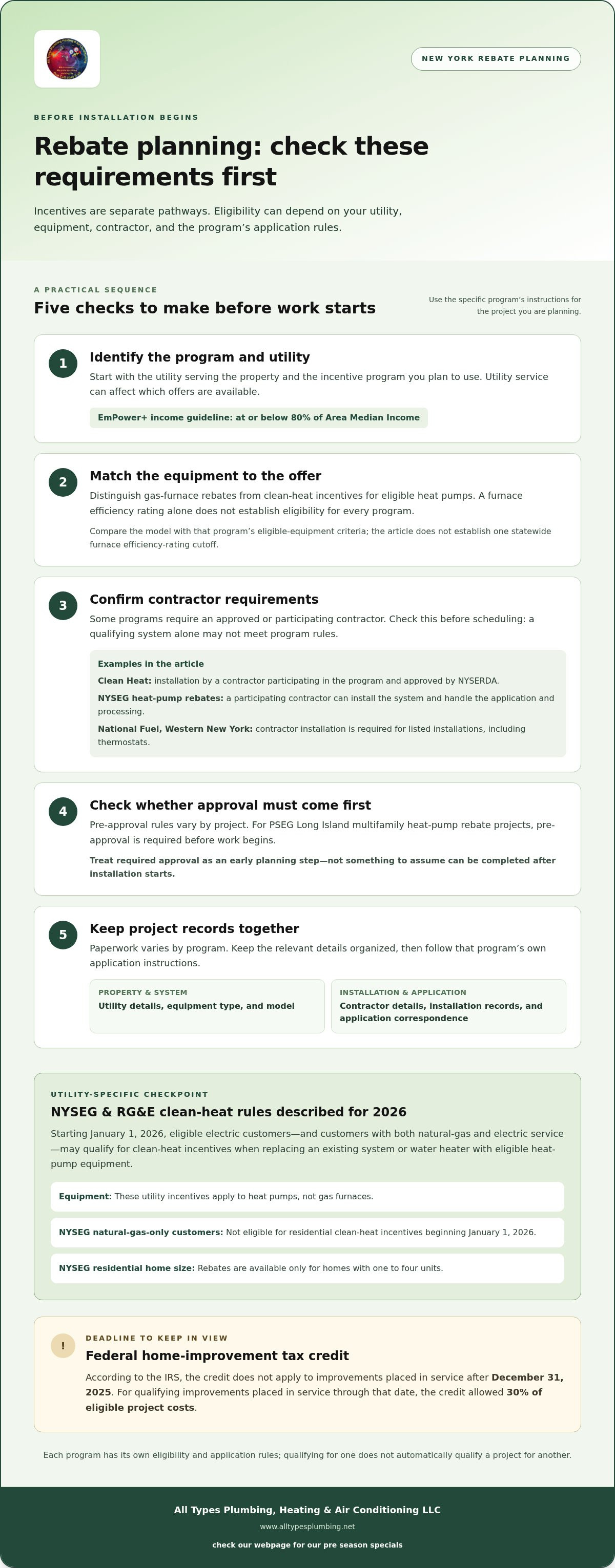
Eligibility, utility service, and equipment type shape the incentives available. When comparing high-efficiency furnace rebates in NY, distinguish gas-furnace offers from clean heat incentives for eligible heat pumps.
Energy Efficiency Upgrade Options
EmPower+ is generally available to households earning at or below 80% of Area Median Income. The available facts don’t establish one statewide furnace efficiency-rating cutoff, so compare a model with the specific program’s eligible-equipment criteria before selecting it.
When reviewing current NYSERDA incentives, distinguish furnace rebates from clean heat offers. A furnace’s efficiency rating alone does not establish eligibility for every program.
Regional Heating Rebate Eligibility
In Western New York, National Fuel’s rebate program requires contractor installation for all listed installations, including thermostats. Upstate eligibility also depends on utility service and equipment. Starting January 1, 2026, NYSEG and RG&E electric customers, plus customers with both natural gas and electric service, may qualify for clean heat incentives when replacing an existing furnace, boiler, or water heater with eligible heat pump equipment. NYSEG natural-gas-only customers aren’t eligible for residential clean heat incentives beginning January 1, 2026.
Starting January 1, 2026, NYSEG residential clean heat rebates are available only for homes with one to four units. These utility incentives apply to heat pumps, not gas furnaces.
Combining Furnace Incentives
Homeowners may be able to use more than one incentive, but each program’s eligibility and application rules determine whether offers can be combined. Treat NYSERDA incentives, utility rebates, and federal tax credits as separate opportunities. Before planning around combined savings, confirm that each applies to the same equipment and project.
According to the Internal Revenue Service, the federal Energy Efficient Home Improvement Tax Credit doesn’t apply to improvements placed in service after December 31, 2025. For qualifying improvements placed in service through that date, the credit allowed 30% of eligible project costs. It cannot be counted for later work.
Rebate Amounts and Installation Costs
The listed facts do not identify a utility offering those specific furnace rebate amounts. NYSEG and RG&E incentives described above concern eligible heat pumps, not gas furnaces. Compare the equipment category and program before estimating savings from high-efficiency furnace rebates in NY.
Furnace installation costs depend on the equipment and work required at the home. Funding is first-come, first-served or available until fully committed. New York’s climate goals target a 40% economy-wide emissions reduction by 2030 and at least 85% by 2050, from 1990 levels.
Contractor and pre-approval requirements
Apply through the utility or program offering the incentive. For NYSEG heat-pump rebates, a participating contractor can install the system and handle the application and processing. Paperwork varies by program, so organize your utility information, equipment details, contractor information, and installation records.
Contractor rules matter because a qualifying system alone may not meet program requirements. New York State Clean Heat rebates require installation by a contractor participating in the program and approved by NYSERDA. If you are considering a clean heat incentive, identify the contractor requirement before scheduling work. Gas-furnace and heat-pump rebates can follow different processes, so match the installer and application route to the equipment.
Participating Contractor Requirements
For a Clean Heat project, use a contractor approved by NYSERDA’s program. A NYSEG participating contractor can install eligible heat-pump equipment and manage its rebate application. In Western New York, National Fuel’s rebate program requires contractor installation for all listed installations, including thermostats. In these programs, the contractor is part of the application process, not just the person completing the work.
Before committing to an installation, organize the key project information:
Confirm which utility or program applies to the property.
Identify the equipment type and model being considered.
Record the contractor’s name and program participation details.
Keep the installation paperwork and any application correspondence together.
These records help keep application details consistent. They also make it easier to distinguish a gas-furnace project from an eligible heat-pump upgrade when reviewing rebate paperwork.
Pre-Approval and Application Steps
Pre-approval rules can depend on the project type. PSEG Long Island requires pre-approval before work begins on multifamily heat-pump rebate projects. Starting installation before approval could put the project out of sequence with program requirements, so make approval an early planning step for multifamily properties.
For NYSEG heat-pump rebates, the participating contractor may handle application submission and processing. Keep copies of the project information and application communications, then follow the program’s stated process for any remaining steps. For a furnace rebate, use the application route tied to that specific offer instead of assuming the heat-pump process applies.
There isn’t one document checklist that applies to every New York rebate. Keep utility details, equipment information, contractor records, and installation documents ready, then use the program’s own application instructions to identify its required submissions. For a planned replacement, hot air furnace installation can be part of the project planning process. Check our webpage for our pre season specials.
Address-based rebate search
A New York address is the starting point for finding rebates related to a home’s location. The address-based search accepts addresses across New York State, helping homeowners identify local offers rather than relying on statewide summaries alone. County can help orient your search, but utility territory, fuel service, equipment, and project type are key distinctions when comparing results.
Do furnace rebates vary by county, utility territory, or fuel type? They can vary by utility and the equipment being installed, while an address helps identify which local programs may apply. Fuel type also matters: NYSEG natural-gas-only customers aren’t eligible for residential clean heat incentives beginning January 1, 2026, while eligible NYSEG and RG&E electric customers, and customers with both natural gas and electric service, may qualify for incentives replacing existing systems with eligible heat pumps.
Use the search as a screening step, then organize results by project. For example, separate a gas-furnace replacement from a clean heat upgrade to an air-source heat pump. These are different equipment categories, and an offer for one should not be assumed to cover the other. NYSERDA’s clean heat incentives apply to qualifying heat-pump installations, while utilities may have their own requirements and application processes.
Enter the home’s New York address in the rebate search.
Note the utility serving the property and the home’s fuel service.
Match each listed offer to the planned equipment and installation.
Review contractor, pre-approval, and application requirements for each program.
Compare more than heating offers. A search may surface incentives for cooling equipment or water heating, which can matter if your household is planning several energy-efficiency projects. A water-heater incentive applies to a water-heating upgrade, not a furnace, so keep the equipment category clear when reviewing potential savings.
Address-based results can also help distinguish statewide programs from utility-specific offers. NYSEG customers, for example, may qualify for heat-pump incentives that vary by system type. Check whether a program covers an air-source or ground-source heat pump and whether its eligibility matches the home’s utility service and planned replacement. This helps you compare realistic options instead of collecting unrelated rebate amounts.
Save the program name and requirements alongside the address-specific result. A brief record of your utility, fuel, equipment, and application steps helps keep a furnace project separate from heat-pump, cooling, and water-heating incentives as you plan.
Application deadlines
New York rebate deadlines depend on the specific program and its funding process. Build a project calendar around the offer tied to your equipment, utility, and application route. A furnace rebate, heat-pump incentive, and loan program can each have different timing requirements. Do not treat a general statewide date as the deadline for every application.
The clearest federal cutoff concerns earlier improvements. According to the Internal Revenue Service, the Energy Efficient Home Improvement Tax Credit doesn’t apply to improvements placed in service after December 31, 2025. If an eligible project was placed in service through that date, its tax-credit timing differs from a utility rebate application. Keep completion and submission dates distinct in your records.
Plan Around Program Funding
Funding availability can affect timing even when a program does not publish a single closing date for all applicants. The New York Energy $mart Loan Program makes funding available on a first-come, first-served basis or until funds are fully committed. If you are planning an upgrade, identify the loan program’s current application steps early and organize the required project information before submitting.
This funding condition differs from a fixed calendar deadline. If you apply later, funds may already be committed, so avoid leaving the loan decision until after choosing equipment. Keep the program name, submission date, and application status with your project documents. This helps you track financing separately from rebate or tax-credit applications.
Allow Time for Processing
NYSEG says heat-pump rebates can take four to six weeks to process. Include that processing period in your plans, especially if coordinating a heat-pump installation with other work. Processing time is not an application deadline and does not mean you can delay any required pre-approval.
For multifamily heat-pump projects through PSEG Long Island, pre-approval is required before work begins. Add approval as a milestone on the project calendar, before installation. Missing the required sequence can create uncertainty about the rebate application, even if the equipment appears to fit the program.
Build a Deadline Checklist
Use a short checklist to keep each opportunity on track:
Record the program’s application deadline or funding condition.
Note whether approval must come before installation.
Track equipment completion, submission, and processing as separate dates.
Save confirmation messages and copies of submitted paperwork.
For example, if you are comparing a gas-furnace rebate with an air-source heat-pump incentive, keep each application’s requirements separate. The equipment category, utility, and program determine which timeline applies. This makes potential savings easier to track and helps prevent one program’s deadline from being mistaken for another’s.
Hudson Valley heating-system rebates
Hudson Valley homeowners can review the Upgrade & Save program for heating incentives. A household can receive no more than 2 Upgrade & Save rebates. Check which eligible equipment and controls match the planned project before counting on a particular amount.
For example, a homeowner considering a boiler replacement should distinguish the equipment rebate from a control upgrade. The household limit of 2 rebates applies to Upgrade & Save participation.
Other New York programs address different home improvements and have separate eligibility criteria. EmPower+ is generally available to households earning at or below 80% of Area Median Income. The Weatherization Assistance Program serves households at or below 60% of state median income, including homeowners and renters in single-family or multifamily buildings.
Weatherization can be relevant before a heating-system change. Insulation and air sealing may help reduce a home’s heating needs, which can affect the equipment selected for a later upgrade. The Weatherization Assistance Program reports average energy savings in excess of 20%. Treat this as a separate program benefit, not as an additional Upgrade & Save rebate.
Income may affect eligibility for some rebate programs. These incentives cover different types of work. A water-heating rebate does not automatically apply to a furnace project.
Identify whether the planned work is a furnace, boiler, control, insulation, or water-heating upgrade.
Check the household’s income against the relevant program criteria.
Track the Upgrade & Save household rebate limit separately from other incentives.
For a Hudson Valley project, keeping the equipment type, income pathway, and program name together helps make the next step clearer. Discuss your heating-system project and how the planned work fits your home’s needs.
All Types Plumbing, Heating & Air Conditioning: Hot water boiler servicing
All Types Plumbing, Heating & Air Conditioning provides hot-water boiler servicing for homeowners who need routine service or help with a boiler concern. If the system needs replacement, the company also installs hot-air furnaces. The right next step depends on your existing equipment and home heating needs, not simply on which rebate appears largest.
Before planning work, keep the equipment type and rebate details together. A furnace incentive may not apply to boiler work, so match the proposed project to the program’s eligible equipment and application requirements. See our webpage for pre-season specials.
For help planning your heating project, contact All Types Plumbing, Heating & Air Conditioning.
Plan the heating work around your home
A rebate can help shape a project, but the next step is to match your equipment choice to your home’s heating needs. Keep your intended upgrade, utility information, and program requirements together as you plan. This gives you a clear starting point for discussing the work and deciding what suits your household.
For high-efficiency furnace rebates in NY, plan for both the equipment and application process. All Types Plumbing, Heating & Air Conditioning LLC installs hot-air furnaces, services hot-water boilers, and upgrades tankless water heaters. Each service addresses a different home-comfort need, so start by identifying the system you have and the change you are considering.
If you’re ready to discuss a heating or water-heating project, contact All Types Plumbing, Heating & Air Conditioning LLC. A practical plan can help you move forward with greater confidence and comfort at home.
Frequently Asked Questions
Who is Eligible?
Eligibility depends on the program, household, utility, and equipment being installed. EmPower+ is generally available to households earning at or below 80% of Area Median Income. Other incentives may be tied to a utility territory or a specific upgrade, such as replacing a gas furnace with eligible heat pump equipment. Start by identifying the property’s utility and planned equipment, then match those details to the program’s criteria.
Why Upgrade Now?
Planning an upgrade before your heating system needs urgent attention gives you time to compare equipment and rebate conditions. You can organize project records, review application steps, and account for any required approval before work begins. For expert guidance on your installation, you can contact All Types Plumbing, Heating & Air Conditioning LLC to help ensure your system meets all requirements. Preparation helps you make an informed choice about home comfort.
What are the income limits for New York furnace rebates or incentives?
There isn’t one income limit for every New York heating incentive. EmPower+ is generally available to households at or below 80% of Area Median Income. The Weatherization Assistance Program uses a different threshold: households at or below 60% of state median income may qualify for its services. These programs cover different kinds of assistance, so identify the specific program before applying its income test.
Must a participating contractor install the furnace to qualify for a New York rebate?
Contractor rules depend on the incentive and equipment. New York State Clean Heat rebates require installation by a participating contractor approved by NYSERDA, and National Fuel’s Western New York rebate program requires contractor installation for all listed installations, including thermostats. When planning your project, professionals at All Types Plumbing, Heating & Air Conditioning LLC can help navigate these guidelines. Confirm that your planned project follows the installer rules for its rebate.
What deadlines, funding limits, or other restrictions apply to New York furnace rebates?
Deadlines and limits vary by program. According to the Internal Revenue Service, the federal Energy Efficient Home Improvement Tax Credit doesn’t apply to improvements placed in service after December 31, 2025. The New York Energy $mart Loan Program’s funding is first-come, first-served or available until fully committed. Some offers also require approval before work begins, so include application steps in your project schedule.
Which New York utility companies offer furnace rebates, and how much are they?
Major New York utility providers, including Con Edison, National Grid, NYSEG, RG&E, and Orange & Rockland, offer various energy-efficiency incentives. Rebate amounts change frequently based on available funding, seasonal promotions, and the specific efficiency rating of the equipment you choose. To maximize your savings, check with your specific utility provider or consult with All Types Plumbing, Heating & Air Conditioning LLC to identify the most current offers available in your local service area.

Comments